MetBox (Meteorological Box)
Status: Contents not yet checked by product owner
Description
The MetBox is a low cost low maintenance and high accuracy package to measure reliably the main essential meteorological parameters such as wind speed and direction, air temperature, humidity and atmospheric pressure.
Measurements are sampled by a microcontroller, then encoded and transmitted. The transmission channel used varies depending on the device version.
Version v0
The v0 was developed in August 2024. This revision included:
- An Arduino Micro to sample the measurements
- The Calypso ULP Standard wind sensor, set to uart interface
- BMP280 and SHT40 pressure and humidity sensors, integrated in an ENV IV
- Two communication interfaces were implemented
- A USB interface, extended with an active extender (for monitoring and firmware update)
- A Serial RS485 interface
- A POM housing
- Radiation guards made from PLM print material, with an additional coatin
-
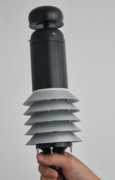 MetBox - Version 0
 -
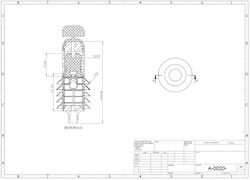 MetBox - Version 0 Technical Drawing
 -
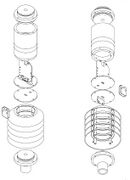 MetBox - Version 0 Exploded view


Version v1
Development of the version V1 was completed in May 2025. The changes introduced were:
- The housing was changed. This version is shorter than the previous,the electronics compartment is, however, wider.
- The housing is meant to be printed and assembled with M4 screws for stability.
- Pow input is connected via a M12 - 5 wire - panel mount connector.
- Sensors are interfaced with an i2c bus.
- A Grove - Wio-E5 (uart) is used for data transfer through LoRaWAN with the FXP890.07.0100C antenna.
- The controller is an Arduino nano IoT 33.
-
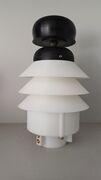 MetBox - Version 1
 -
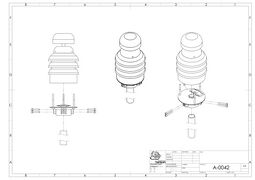 MetBox - Version 1 Technical Drawing
 -
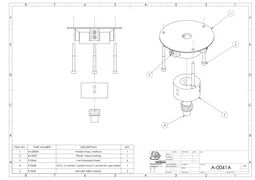 MetBox - Version 1 Bottom assembly


Circuit schematic

Measurement Parameters (extern)
| SENSOR PARAMETER | MANUFACTURER | MODEL | INTERFACE | UNIT | RANGE | ACCURACY | Registry UUID |
|---|---|---|---|---|---|---|---|
| AIR TEMPERATURE | Sensirion | SHT40 | i2c | °C | -40-125 | 0.2 | |
| ATMOSPHERIC PRESSURE | Bosch | BMP280 | i2c | hPa | 300-1100 | ~ ±1 hPa (abs)
± 0.12 hPa (relative) |
|
| HUMIDITY | Sensirion | SHT40 | i2c | % | 0-100 | 1.8 | |
| WIND SPEED | Calypso Instruments | ULP Standard | uart / i2c | m/s | 0.5 - 45 | ± 0.3 | |
| WIND DIRECTION | Calypso Instruments | ULP Standard | uart / i2c | ° (degrees) | 0-359 | ± 1 |
Note:
Wind directions shown are where the wind comes from, according to the standard meteorological convention (e.g., 0° = wind from the North, 90° = from the East, etc.).
Technical Requirements for Operators (extern)
Where to install the instrument on the ship?
Preferably on the main mast or at a high place where the air stream is not obstructed.
What power supply does the instrument require?
Version v1
6 - 21 VDC
Power consumption < 200 mW (unoptimized)
The connector selected is a m12 5 pole, panel mounted. The pinout is (also described in detail in the Circuit schematic section):
| Pole | Color | Description |
|---|---|---|
| 1 | brown | Not used |
| 2 | white | vcc |
| 3 | blue | gnd |
| 4 | black | can H (planned) |
| 5 | grey | can L (planned) |
What is the size of the instrument?
28 x 11 x 11 cm
Version v1
20 x 11 x 11 cm
Water proofness
Splash proof
What maintenance does the instrument require?
System cleaning of the system once a year or before, if needed.
How will data be transferred?
Version v0
Serial (RS485)
Version v1
LoRaWan
Wifi, Bluetooth planned
uart planned
Costs
Material costs ~500 EUR
Technichal Details
Development status
7
Expected date for market readiness
Not clear yet
Commercial availability
Autonomous operation
Data
Data transmission
Version v1
Data is encoded to hexadecimal and sent via LoRaWan to a TTN project. Inside the TTN console, a javascript payload formatter decode the data and asigns the o2a tags, following lorawan data flow.
How to install?
A m12, 5 pole female connector can be attached to provide power.
A tube can be attached to the bottom part and secured with 6x M4 screws mounted radially. The opening allows a tube with a max OD of Ø45 mm and min ID of Ø20 mm. A bushing can be used to increase stability, in addition to the tube.

How to operate?
If a LoRaWan coverage is avaliable, the device is plug and play.
How to calibrate?
Further details
Product experts: Jochen Horstmann and Alejandro Ordóñez (HEREON)