Lagrangian Drifter: Difference between revisions
Created page with "Category:technology Status: Contents not yet checked by product owner == Description (extern) == The Lagrangian Drifters were designed and built at Helmholtz-Zentrum Hereon to follow the upper surface flow (approx. 50 cm). The main body of the Lagrangian Drifters consists of a 11 cm x 19 cm long tube with a flotation ring at the top. It is attached to a drogue of 35 cm in both length and diameter through a flexible cord within a distance of 10 cm to the tube. When..." |
|||
| Line 3: | Line 3: | ||
Status: Contents not yet checked by product owner | Status: Contents not yet checked by product owner | ||
== Description | == Description == | ||
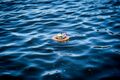
The Lagrangian Drifters were designed and built at Helmholtz-Zentrum Hereon to follow the upper surface flow (approx. 50 cm). The main body of the Lagrangian Drifters consists of a 11 cm x 19 cm long tube with a flotation ring at the top. It is attached to a drogue of 35 cm in both length and diameter through a flexible cord within a distance of 10 cm to the tube. When deployed about 5 cm of the tube protrude from the water surface, resulting in a ratio of drag area inside to drag area outside the water of > 20. The tube contains a battery pack and an electronic board, which acquires and reports the collected data via a global satellite network in near real time. Two versions are available of which the simple version only reports date, time and position, at a predefined time interval (e.g. every 5 minutes), which enables to estimate surface current direction and speed. The version 2 measures in addition water temperature, air temperature and atmospheric pressure and can easily be equipped with additional sensors (e.g. salinity). <gallery mode=" | The Lagrangian Drifters were designed and built at Helmholtz-Zentrum Hereon to follow the upper surface flow (approx. 50 cm). The main body of the Lagrangian Drifters consists of a 11 cm x 19 cm long tube with a flotation ring at the top. It is attached to a drogue of 35 cm in both length and diameter through a flexible cord within a distance of 10 cm to the tube. When deployed about 5 cm of the tube protrude from the water surface, resulting in a ratio of drag area inside to drag area outside the water of > 20. The tube contains a battery pack and an electronic board, which acquires and reports the collected data via a global satellite network in near real time. Two versions are available of which the simple version only reports date, time and position, at a predefined time interval (e.g. every 5 minutes), which enables to estimate surface current direction and speed. The version 2 measures in addition water temperature, air temperature and atmospheric pressure and can easily be equipped with additional sensors (e.g. salinity). <gallery mode="nolines"> | ||
File:Lagrangian Drifter | File:Lagrangian Drifter.jpg|Lagrangian Drifter | ||
File:Lagrangian Drifter | File:Lagrangian Drifter 2.jpg | ||
</gallery> | </gallery> | ||
== Measurement Parameters | == Measurement Parameters == | ||
{| class="wikitable" | {| class="wikitable" | ||
!SENSOR PARAMETER | !SENSOR PARAMETER | ||
| Line 84: | Line 84: | ||
|} | |} | ||
== Technical Requirements for Operators | == Technical Requirements for Operators == | ||
=== Where to install the instrument on the ship? === | === Where to install the instrument on the ship? === | ||
| Line 103: | Line 103: | ||
=== How will data be transferred? === | === How will data be transferred? === | ||
Data will be automatically transferred via satellite on a predefined schedule e.g. every 5 minutes. | Data will be automatically transferred via satellite on a predefined schedule e.g. every 5 minutes. | ||
=== Costs === | === Costs === | ||
| Line 152: | Line 112: | ||
== Collaboration(s) == | == Collaboration(s) == | ||
We started talking to two companies at the moment (Helzel Messtechnik and Sea & Sun) | We started talking to two companies at the moment (Helzel Messtechnik and Sea & Sun) | ||
== Development status == | == Development status == | ||
| Line 161: | Line 118: | ||
TRL 7 | TRL 7 | ||
=== | === Commercial availability === | ||
[https://mstdev.de/ Marine Science and Technology] | |||
Contact person: Jan Widera | |||
=== Autonomous operation === | === Autonomous operation === | ||
Lagrangian Drifters are fully autonomous after deployment. | Lagrangian Drifters are fully autonomous after deployment. | ||
== Data == | == Data == | ||
=== Data transmission === | === Data transmission === | ||
=== Data visualisation === | === Data visualisation === | ||
== How to install? == | == How to install? == | ||
Revision as of 14:28, 2 January 2026
Status: Contents not yet checked by product owner
Description
The Lagrangian Drifters were designed and built at Helmholtz-Zentrum Hereon to follow the upper surface flow (approx. 50 cm). The main body of the Lagrangian Drifters consists of a 11 cm x 19 cm long tube with a flotation ring at the top. It is attached to a drogue of 35 cm in both length and diameter through a flexible cord within a distance of 10 cm to the tube. When deployed about 5 cm of the tube protrude from the water surface, resulting in a ratio of drag area inside to drag area outside the water of > 20. The tube contains a battery pack and an electronic board, which acquires and reports the collected data via a global satellite network in near real time. Two versions are available of which the simple version only reports date, time and position, at a predefined time interval (e.g. every 5 minutes), which enables to estimate surface current direction and speed. The version 2 measures in addition water temperature, air temperature and atmospheric pressure and can easily be equipped with additional sensors (e.g. salinity).
-
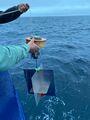 Lagrangian Drifter
 -


Measurement Parameters
| SENSOR PARAMETER | MANUFACTURER | MODEL | INTERFACE | UNIT | RANGE | ACCURACY | Registry UUID |
|---|---|---|---|---|---|---|---|
| DATE | |||||||
| TIME | |||||||
| LATITUDE | |||||||
| LONGITUDE | |||||||
| AIR TEMPERATURE | Bosh | ||||||
| WATER TEMPERATURE | |||||||
| ATMOSPERIC PRESSURE | Bosh |
Technical Requirements for Operators
Where to install the instrument on the ship?
Lagrangian Drifters are dropped over board underway sailing.
What power supply does the instrument require?
The drifter is powered by 4 x 1.5V D-cell batteries. The power consumption for Version 1 is approx. 20 mW and for Version 2 approx. 30 mW.
What is the size of the instrument?
The size of the main body is 23 x 19 x 19 cm, the drifters underwater sail has a size of 35 x 35 x 35 cm and can be folded to a sheet 35 x 35 x 0.5 cm.
Water proofness
The drifter is water proof up to a water depth of approx. 1 m
What maintenance does the instrument require?
Lagrangian Drifters are typically not recovered. However in case they are recovered they should be cleaned, batteries need to be replaced and test of all sensors should be undertaken.
How will data be transferred?
Data will be automatically transferred via satellite on a predefined schedule e.g. every 5 minutes.
Costs
Cost of material for version 1 is approx. 300 Euro and for version 2 approx. 600 Euro
Technichal Details
Will follow soon!
Collaboration(s)
We started talking to two companies at the moment (Helzel Messtechnik and Sea & Sun)
Development status
TRL 7
Commercial availability
Contact person: Jan Widera
Autonomous operation
Lagrangian Drifters are fully autonomous after deployment.
Data
Data transmission
Data visualisation
How to install?
How to operate?
How to calibrate?
Further details
Product Owners: Ruben Carrasco, Jochen Horstmann, Alejandro Ordóñez, Michael Streßer (HEREON)